


Implant Based Breast Reconstruction
Conveniently located to serve the areas of Beverly Hills, West Hollywood and Los Angeles, CA

In the current advent of community outreach and public education about breast cancer and the importance of early detection as well as the findings of certain key genes and gene combinations that predispose patients to having breast cancer has allowed oncological surgeons to safely remove the breast yet spare the breast skin envelope and oftentimes the nipple-areolar complex such that as plastic surgeons who are experienced in breast reconstruction can then reconstruct the breast by placing the permanent implant at the time of the mastectomy. The patient who is indeed a good candidate for this type of reconstruction, then will be spared the second stage of exchanging the tissue expander for a permanent implant, will save one additional trip to the operating room, and further steps in creating the nipple-areolar complex and tattooing.
Contents
Direct to Implant Breast Reconstruction
Before and After Photos


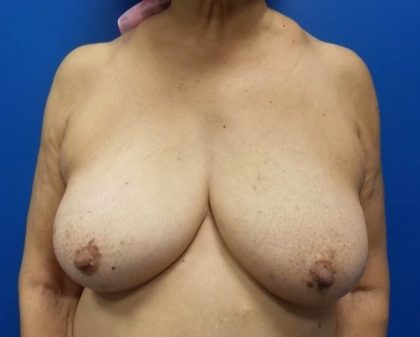
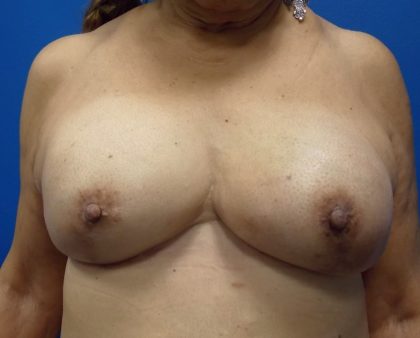


The patient selection is key however, and that is done in consultation with the breast oncological surgeon who will be removing the breast, the patient’s medical oncologist, and their trusted plastic surgeon, me, to make sure that the patient is indeed a good candidate to have this type of same time implant reconstruction where the final outcome appears most natural as the incision on the breast is same as in cosmetic breast augmentation; either along the edge of the areola or along the breast fold. The patient, therefore, wakes up after surgery with a new set of breasts that look like and sometimes look better than their original breasts as they are slightly uplifted or if the patient had breast volume asymmetry, is corrected at the same time as the mastectomy.

The role of an ADM (acellular dermal matrix) and its proper use is key to the successful single stage implant breast reconstruction. In the traditional two stage process, a tissue expander is first inserted at the time of the mastectomy. In general, the mastectomy also removes the nipple-areolar complex and an island of breast skin around the nipple areolar complex. This tissue expander is therefore needed to stretch the skin surface and with time recruit more skin to replace what was removed with the mastectomy. However, because stretching the skin alone may further thin the skin and compromise its integrity, the tissue expander is placed under the pectoral or chest muscle to help support the overlying skin and along the lower half of the breast, the ADM is fashioned to act as an internal brasserie or like a hammock it supports the implant or the tissue expander along its lower half as the chest muscle does not naturally extend to cover the whole lower half of a natural breast. The tissue expander is then slowly filled with sterile normal saline to stretch the chest muscle, skin and the ADM until a desired volume of a breast mound is reached. After an adequate waiting period to allow for stretch relaxation to occur, the tissue expander is exchanged for a permanent implant. The use of an ADM has allowed plastic surgeons to reconstruct the breast after mastectomy in a single stage because in these patients, significant breast skin is not removed, and in older patients, in fact, the skin of the breast is already overstretched and therefore, a skin lift is done as the same time as the breast implant reconstruction. The ADM is used therefore as an internal brasserie to help support the underlying implant along its lower half and the upper border of the ADM is sewn to the lower edge of the pectoral or chest muscle. Because the skin of the breast and nipple areolar complex has remained intact, the reconstructed breast looks similar to the breast that was not removed.
Staged Tissue Expander to Breast Implant Reconstruction
Before and After Photos


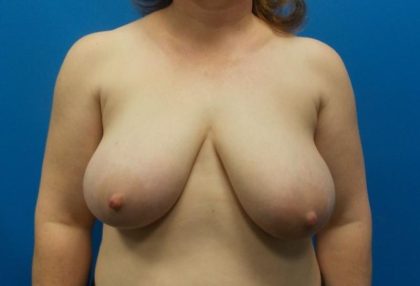
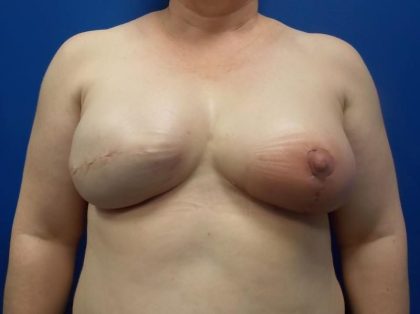
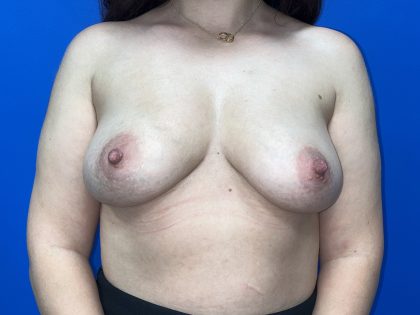
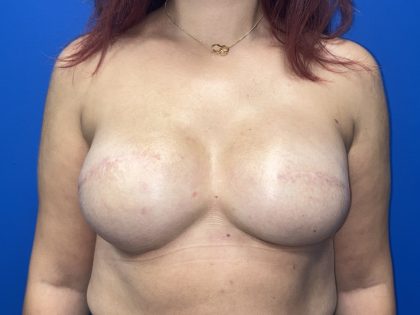
A two stage procedure is used to reconstruct the breast with implants. First, a tissue expander is inserted underneath the muscles of the chest after the mastectomy. The pectoralis muscle is elevated and a piece of human ADM is used to span the gap between the lower edge of the elevated pectoral muscle and the chest wall so that the expansion is done more comfortably. In the ensuing weeks to months, this device is slowly expanded as the body learns to accommodate the expander and the chest tissues stretch and begin to relax in preparation for the second stage of the procedure.
After a waiting period of six to twelve weeks, the patient is brought back to the operating room for the second stage when the expander is removed and replaced with an implant. The final implant can be saline or silicone gel.
About Dr. Mossi Salibian
Board-Certified Plastic Surgeon · Plastic Surgery by Salibian
- Board certification
- Education and training
- Medical School: August 1990 – May 1994
- Boston University School of Medicine, Boston, Massachusetts
- Doctorate in Medicine, May 1994
- Graduate: August 1988 – May 1990
- Boston University Graduate School of Arts and Sciences, Boston, Massachusetts
- Department of Microbiology and Immunology
- Concentration in Immunology, May 1990
- Undergraduate: September 1984 – May 1988
- Boston College, Chestnut Hill, Massachusetts
- Bachelor of Science in Biochemistry, May 1988
- Clinical Specialist: July 2001 – June 2002
- July 1999 – June 2001
- Clinical Assistant Instructor: July 1994 – June 1999
- State University of New York Health Science Center at Brooklyn and Affiliated Hospitals (Downstate Medical Center), Brooklyn, New York
- Doctorate in Medicine, Boston University School of Medicine (1994)
- Master of Arts in Medical Science, Concentration in Immunology, Boston University Graduate School of Arts and Sciences (1990)
- Bachelor of Science in Biochemistry, Boston College (1988)
- Internship, SUNY-HSC at Brooklyn (1994–1995)
- Surgical Residency, SUNY-HSC at Brooklyn (1995–1999)
- Chief Residency, SUNY-HSC at Brooklyn (1998–1999)
- Residency in Plastic and Reconstructive Surgery, Nassau University Medical Center / New York Plastic Surgical Group (1999–2001)
- Fellowship in Oncologic Microvascular Reconstructive Plastic Surgery, The University of Texas M. D. Anderson Cancer Center, Houston, Texas (2001–2002)
- Certificate in Microvascular Reconstructive Surgery, June 30, 2002
- Residency, General Surgery, SUNY-HSC at Brooklyn (1995–1999)
- Hospital affiliations
- Cedars-Sinai Medical Center, Los Angeles CA
- Glendale Memorial Hospital, Glendale, CA
- Glendale Adventist Medical Center, Glendale, CA
- Kaiser Permanente Bellflower Medical Center, Bellflower, CA
- UCLA Olive View Medical Center
- Memberships
- American Society of Plastic Surgeons
- Awards
- National Cancer Institute Student Research Fellowship, NIH, Bethesda, MD, Summer 1988
- Surgical Chief Resident Teacher of the Year 1999 – Golden Apple Award, SUNY-HSC at Brooklyn, New York
- Certificate of 20 Years of Service from Cedars Sinai Medical Center, LA
- In recognition and appreciation of 15 years of outstanding service to Glendale Memorial Hospital and Health Center
- NPI
- 1386780633